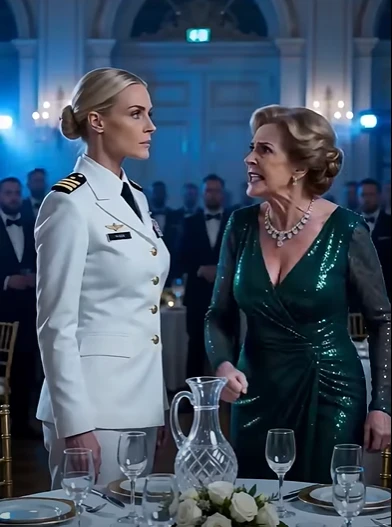
Colonel Vance took a step closer to Thorne, his silver eagles catching the yellow light. He lowered his voice, dropping it into that intimate, conspiratorial tone that senior officers use when they are about to make a problem disappear. “Let’s be pragmatic here, Marcus. You’ve got a clean twenty years in. You’re looking at a retirement packet next spring. A scandal of this magnitude—an extortion ring inside a basic training unit under your direct watch? It doesn’t just look bad for my son. It looks fatal for your career. The battalion commander will have no choice but to relieve you for cause. Your pension, your benefits, the clean record you spent two decades bleeding for… gone. All because you wanted to play detective for a private who won’t even remember your name in six months.”
The silence that followed was suffocating. I watched Thorne’s profile. I saw the way his fingers tightened behind his back, the leather-like skin of his knuckles turning a stark, bloodless white. This was the moment where the old world usually won. This was the turning point where the men with the silver eagles and the clean hands explained the math of survival to the men who actually fought the wars, and the men who fought the wars looked at their families, looked at their mortgages, and looked away.
I knew that choice. I had seen it made in the living room of our house in Savannah. I had seen the local police officers stand on our porch, look at my father’s dress uniform hanging in the hall, look at my mother’s swollen lip, and say, “Why don’t you boys take a walk around the block and cool off? Service life is stressful, we get it.” Everyone always understood the stress of the man with the rank. No one ever gave a damn about the person bleeding on the linoleum.
I reached into my pocket, my fingers wrapping around the cold casing of the digital recorder. I was ready to step forward. I was ready to play the card my sister Rachel had given me—the name of the three-star general at the Pentagon who had signed her death certificate and told my mother that if we ever needed anything, we should call a specific, unlisted number that bypassed the entire Department of the Army.
But before I could move, Thorne spoke.
“My retirement packet doesn’t matter, Colonel,” Thorne said. His voice wasn’t loud, but it had a strange, vibrating resonance that seemed to make the metal roof of the depot hum. He turned his head, looking directly into the Colonel’s silver-haired face. “In 2012, I was a squad leader in Sangin. We were surrounded, out of ammunition, and my radio operator was dying in my arms. I had given up, sir. I was looking at the sky, waiting for the final push. And then a woman I’d never seen before walked out of the dust. She didn’t have a name tape. She didn’t have a rank. She had a shattered trident on her shoulder and a rifle that didn’t stop firing until the perimeter was clear. She gave me fifteen more years of life, Colonel. She gave me a chance to come home and see my daughter grow up.”
Thorne stepped around the workbench, his massive bulk moving between Colonel Vance and me, shielding me completely from the officer’s gaze.
“The girl standing behind me is Sarah Miller,” Thorne said, his voice rising, filling the entire cavernous space of the bay. “She is the sister of Rachel Miller—the operator who pulled my men out of that draw. Her family gave everything to this country, and they did it in the dark, without medals, without parades, and without a colonel daddy to protect them. Your son didn’t just assault a recruit tonight, sir. He laid hands on the bloodline of Task Force Blackwood. And if you think your little friends in the E-Ring can protect him from what happens next, you are the most foolish man who ever wore those eagles.”
Colonel Vance froze. The smooth, practiced confidence on his face didn’t just fade; it curdled. He looked past Thorne’s shoulder, his eyes locking onto the dark ink on my arm, searching the precise line work, the heavy, blue-tinted Soviet ink that could not be faked. He knew the name. Anyone who had spent the last fifteen years navigating the upper echelons of the Pentagon knew the name Blackwood—the joint-special operations command that operated outside the budget, outside the law, and answered only to the National Security Council.
“Blackwood…” the Colonel whispered, the word slipping out of his mouth like a secret he hadn’t meant to share. He looked at his son, who was still sitting inside the wire cage, his face pale and confused, completely unaware of the mountain that had just fallen on his head.
„Das Logbuch bleibt bei mir, Colonel“, sagte Thorne mit kalter, unmissverständlicher Stimme. „Morgen um 8:00 Uhr werde ich es persönlich dem zuständigen Agenten im CID-Büro übergeben. Ihr Sohn wird gemäß den Richtlinien behandelt. Sollten Sie versuchen, sich einzumischen, sollten Sie versuchen, Ihr Amt zu missbrauchen, um die Logbücher zu verändern oder den Bataillonskommandeur zu beeinflussen, werde ich persönlich eine digitale Kopie dieser Aufzeichnung an den Generalinspekteur und alle Nachrichtenagenturen von hier bis Chicago senden. Mal sehen, wie Ihre Beförderung zum Brigadegeneral aussieht, wenn die Washington Post auf der Titelseite über einen Offizier berichtet, der seine Position missbraucht hat, um einen Ring sexueller Erpressung auf einem Ausbildungsstützpunkt zu vertuschen.“
Oberst Vance antwortete nicht. Er stand dreißig lange, quälende Sekunden mitten in der Bucht, sein Atem in kurzen, unsichtbaren Stößen in der kalten Luft. Die silbernen Adler auf seinen Schultern wirkten nun schwer, wie Bleigewichte, die ihn in den Dreck zogen. Er sah seinen Sohn ein letztes Mal an – nicht wütend, nicht liebevoll, sondern mit der kalten, berechnenden Distanz eines Politikers, der gerade entschieden hatte, dass ihm ein Ballast zu teuer geworden war.