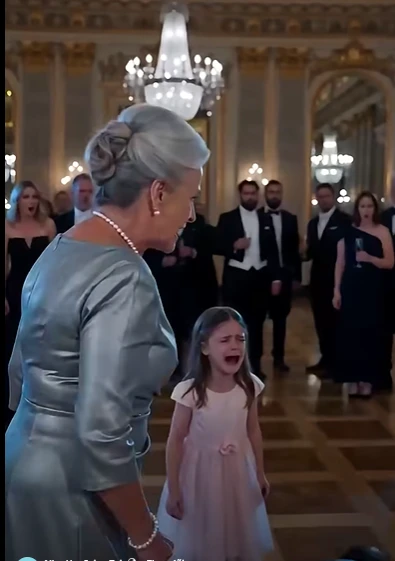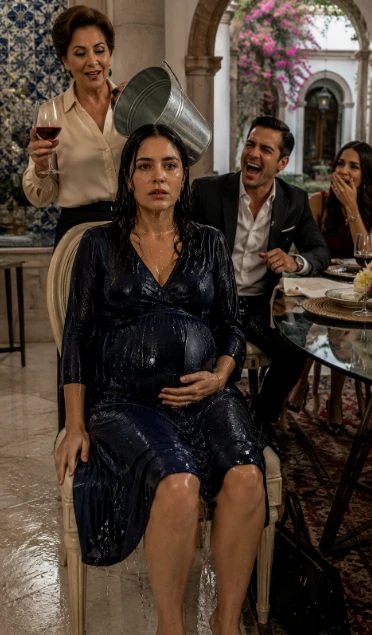

Crystal glasses hovered halfway to painted lips.
The orchestra’s final violin note faded beneath the chandeliers.
My father stood alone near the back of the ballroom in the same charcoal suit he had worn to my college graduation twelve years earlier.
The sleeves were a little too short now.
His shoes had been polished so carefully that the cracks in the leather shone.
Around his neck was my grandfather’s navy tie, slightly faded at the edges and probably worth less than one bottle of champagne on the nearest table.
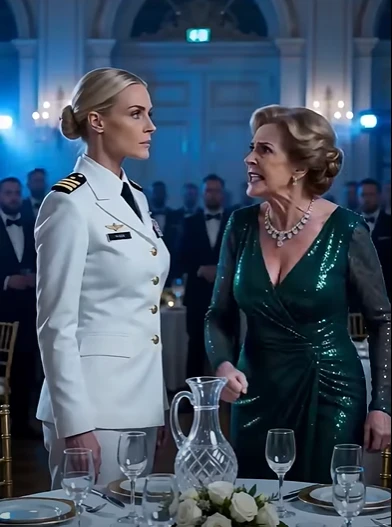
Beverly looked him up and down.
Then she smiled.
Not the warm smile she used for photographs.
Not the gracious smile she gave donors and politicians.
This was the smile of someone who had finally decided she no longer needed to pretend.
“That isn’t a father,” she said.
She waited until the room became completely still.
“That’s trash someone forgot to take out.”
The first laugh came from a man at George Martinez’s table.
Then another.
Then twenty.
Soon, laughter rolled through the ballroom beneath the golden chandeliers.
Some guests laughed because they genuinely thought it was funny.
Others laughed because George Martinez was worth billions, and wealthy people have always attracted a special species of coward.
A few stared at their plates.
A few looked horrified.
Nobody stood up.
Nobody told Beverly to stop.
And then I heard Fiona laugh.
My bride covered her mouth delicately with one hand.
“Mom,” she said between giggles.
“You’re going to embarrass him.”
She meant my father.
Not Beverly.
Not herself.
Not the five hundred people laughing at a sixty-eight-year-old man who had spent his entire life working with his hands.
Him.
Something inside me became perfectly still.
There are moments when your life changes loudly.
Cars crash.
Doctors deliver diagnoses.
Doors slam.
And then there are moments when everything changes without making a sound.
For me, it happened while looking at the woman I had planned to spend the rest of my life with.
I saw her perfectly for the first time.
And I wished desperately that I had seen her sooner.
My father’s name was Thomas Henderson.
Most people who met him would have described him as ordinary.
He repaired commercial heating systems, serviced industrial boilers, and occasionally took construction jobs when old friends needed an experienced pair of hands.
He drove a thirteen-year-old Ford pickup.
He lived in the same small brick house where I had grown up.
He owned exactly three suits.
One was for weddings.
One was for funerals.
The third no longer fit.
He had never cared much about appearances.
Life had stripped that vanity out of him early.
My mother, Claire, died when I was nine.
Cancer took her in eleven brutal months.
Dad was thirty-nine when he became both parents to a frightened child.
He worked before sunrise and often returned after dark.
Yet somehow he never missed parent-teacher conferences.
He learned to cook three meals well enough that I stopped complaining.
He taught himself algebra again because I was struggling.
When money became tight, he claimed he had developed a sudden dislike of steak so I could eat the last piece.
When the furnace failed one January, he slept beside it for two nights so he could restart it whenever the flame died.
When I received my university acceptance letter, he sat at our kitchen table reading it over and over.
I eventually realized he was crying.
He turned his face away and blamed the onions.
There were no onions.
My father never told me what he sacrificed.
He considered sacrifice something a parent did, not something a child owed gratitude for.
Years later, I understood what that had cost him.
I understood it especially well whenever I entered the Martinez family’s world.
I met Fiona three years before our wedding.
She was intelligent, magnetic, and astonishingly good at making you feel like the most interesting person in the room.
We met at a charity event connected to an engineering conference.
I was a structural engineer working for a midsized firm.
She managed philanthropic projects for Martinez Global Infrastructure, the multinational company her grandfather had founded.
People assumed Fiona was another rich heiress with an ornamental job.
She hated that assumption.
At least, she told me she did.
She could speak convincingly about affordable housing, apprenticeships, and worker safety.
She remembered waiters’ names.
She volunteered at hospitals without photographers.
She laughed loudly when nobody important was watching.
I fell in love faster than I admitted.
For almost a year, we were happy.
Then I met her family.
George Martinez had the kind of presence money creates after several generations.
He rarely raised his voice because nobody around him required shouting.
He entered rooms expecting chairs to move and conversations to pause.
Beverly was different.
She was elegance sharpened into a weapon.
Everything she said sounded polite until you considered it later.
When she first met my father, she clasped his hand and said, “How wonderful that Blake remains so connected to his roots.”
Dad smiled.
“So far my roots haven’t complained.”
Beverly didn’t laugh.
George asked him what he did for a living.
“Mechanical systems mostly,” Dad replied.
“He fixes furnaces,” I explained.
George nodded slowly.
“How useful.”
Two words.
Nothing openly cruel.
Yet somehow the sentence managed to reduce forty years of labor into something vaguely embarrassing.
The warning signs multiplied after that.
At Christmas, Beverly asked whether Dad would feel “more comfortable” eating in the staff dining room because several business partners were visiting.
Fiona immediately insisted her mother had misunderstood the seating arrangement.
I believed her.
At George’s birthday, Dad arrived in his old charcoal suit.
Beverly asked Fiona whether someone could “help Thomas find something appropriate.”
Dad pretended not to hear.
I heard perfectly.
During wedding planning, George repeatedly asked whether my side of the family understood the dress code.
“There are only eighteen people on my side,” I finally said.
“I think they can read an invitation.”
George smiled.