“Of course.”
Then Beverly removed my aunt from the front table.
She moved my childhood friend Marcus behind a decorative column.
She suggested Dad sit at table twenty-seven because the front tables needed to be reserved for “investors and board members.”
That was when we had our first serious argument.
“He’s my father,” I told Fiona.
“I know.”
“Then why is he sitting behind people I’ve never met?”
“It isn’t personal.”
“It feels personal.”
Fiona rubbed her temples.
“Blake, my parents are spending almost two million dollars on this wedding.”
“I didn’t ask them to.”
“That isn’t the point.”
“It’s becoming the point.”
She stared at me for several seconds.
Then her expression softened.
“You know what my family is like.”
That sentence should have frightened me more than it did.
Instead, I accepted her apology.
Love can turn intelligence into an accomplice.
You notice the red flags, then quietly sew them into curtains so the room still looks beautiful.
The strangest detail concerned the actual marriage.
George insisted that our enormous cathedral ceremony be symbolic.
The legal civil signing would happen privately near midnight, after the reception, before a retired judge who was a longtime Martinez family friend.
Their attorneys described it as a family tradition involving trusts, property agreements, and “administrative convenience.”
I thought it was ridiculous.
Fiona laughed and told me rich families complicated everything.
I signed the prenuptial agreement.
I attended meetings with lawyers.
I answered questions about assets I barely possessed.
And eventually I stopped asking why the official marriage certificate had to wait until 11:45 that night.
That mistake almost changed my entire life.
Our wedding reception took place at the Bellamy Grand.
The ballroom looked like something built for royalty.
White roses covered twenty-foot walls.
Golden lights hung beneath crystal chandeliers.
An orchestra played beside a fountain filled with floating candles.
Champagne flowed down a glass tower taller than a child.
There were five hundred and twelve guests.
I personally knew perhaps seventy.
Dad knew nineteen.
He arrived early.
Of course he did.
He found me alone in a side room adjusting my cuff links.
For several seconds, he simply looked at me.
Then he smiled.
“You look terrified.”
“I’m getting married.”
“Exactly.”
I laughed.
He reached forward and straightened my tie.
His hands were rough.
A pale scar crossed his right thumb.
There was black grease beneath one fingernail despite how hard he had scrubbed.
“You sure?” he asked.
I knew what he meant.
Not about marriage generally.
About Fiona.
About them.
I looked toward the ballroom doors.
“I love her.”
Dad nodded.
“That wasn’t my question.”
I met his eyes.
Something about his expression bothered me.
He seemed sad.
Not nervous.
Not sentimental.
Sad.
“What are you trying to tell me?”
He shook his head.
“Nothing you should hear from me.”
“Dad.”
“A man deserves to choose his own life without his father choosing enemies for him.”
I stared at him.
“What does that mean?”
He smiled faintly.
“It means I love you.”
Before I could ask anything else, someone called my name.
Dad squeezed my shoulder.
Then he walked toward the ballroom.
I would replay that conversation dozens of times afterward.
Only later would I understand that my father had entered that wedding already knowing something that could have destroyed it.
He simply refused to destroy it for me.
He wanted me to choose.
At 9:18 that evening, George stood to make his toast.
His tuxedo probably cost more than Dad’s truck.
“Before we officially welcome Blake into our family,” he began, “I think it’s appropriate that we remember where everyone comes from.”
A soft ripple of laughter followed.
I glanced toward Dad.
He lowered his eyes.
George continued.
“My father always said origins matter.”
Another pause.
“Although apparently some origins require more imagination than others.”
More laughter.
My stomach tightened.
I looked toward Fiona.
She smiled awkwardly.
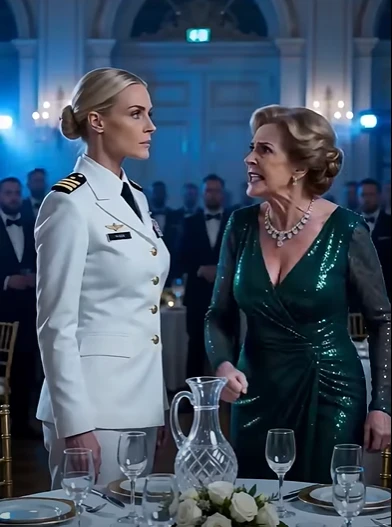
Then Beverly stood.
She didn’t have a microphone.
She didn’t need one.
Her voice carried beautifully.
Her eyes settled on my father.
She examined him from his old shoes to his narrow tie.
Then came the sentence that ended everything.
“That isn’t a father.”
She smiled.
“That’s trash someone forgot to take out.”
The laughter exploded.
And Fiona joined them.
That was the part I could never forgive.
Not immediately.
Not eventually.
Not ever.
I looked at Dad.
He didn’t seem angry.
That somehow made it worse.
His shoulders had moved inward by perhaps half an inch.
Nobody else would have noticed.
I did.
I had seen that posture when bills covered our kitchen table.
I had seen it when another father mocked his truck at my school.
I had seen it when a restaurant manager once assumed he was maintenance staff and told him to use the service entrance.
My father had swallowed humiliation all his life because he refused to make his pain someone else’s burden.
And now he was doing it at my wedding.
I stood.
My chair scraped across the marble floor.
The laughter faded.
Fiona looked up.
“Blake?”
I removed my ring.
Technically, it was ceremonial.
The legal marriage had not happened yet.
I placed it beside my untouched glass of champagne.
“The wedding is over.”
For three seconds, nobody understood.
Then Fiona grabbed my wrist.
“What?”
“We’re done.”
Her face emptied.
“Stop.”
“I mean it.”
“Blake, sit down.”
George’s chair slammed backward.
“Enough.”
His voice cracked through the room like a gunshot.
“You’re emotional.”
I turned toward him.
“No.”
“Sit down.”
“No.”
His eyes hardened.
“Do you understand what this event cost?”
I looked around.
At the roses.
At the orchestra.
At the photographers.
At five hundred elegantly dressed witnesses.
Then I looked at my father.
“Yes.”
My voice came out surprisingly calm.
“I know exactly what it cost.”
Beverly folded her arms.
“You are making a catastrophic mistake.”
“Maybe.”
“A man like you does not receive many opportunities to marry up.”
Something changed inside me.
Not anger.
Clarity.
“You think I’m marrying up?”
She almost smiled.